Most accidents do not happen because drivers are reckless. They happen because drivers cannot see clearly. At night, in rain, in fog visibility collapses fast, and the road becomes a guessing game.
The numbers confirm this. Only about 25% of all driving happens at night, yet roughly 50% of all traffic fatalities occur during those hours. That gap has one major engineering answer: reflective sheets.
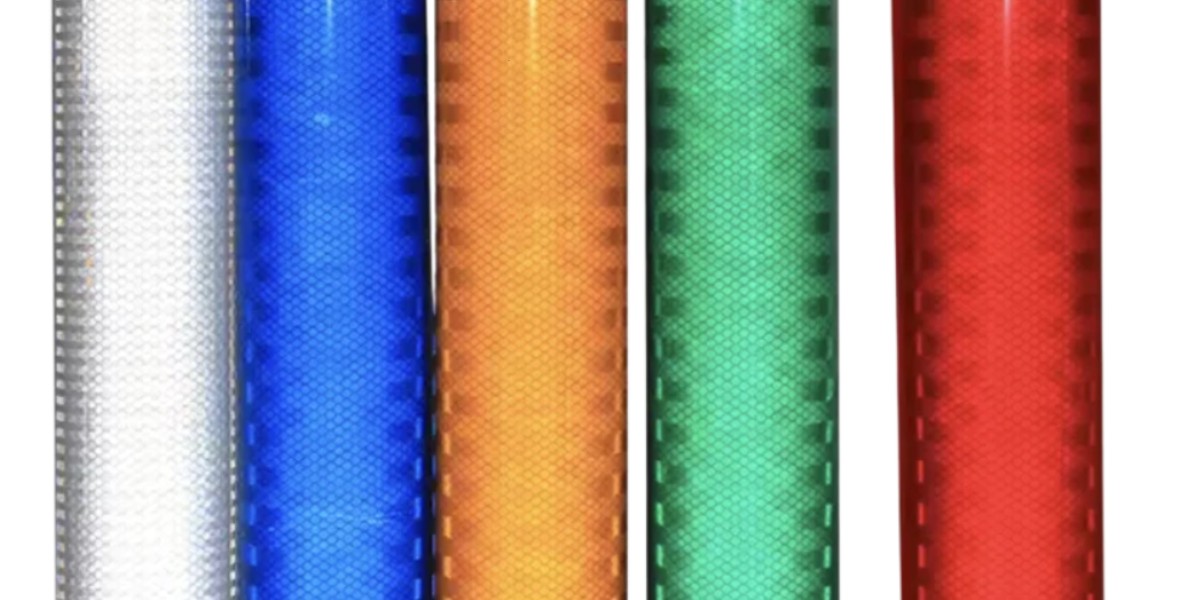
Reflective sheets are retroreflective films applied to road signs, lane markings, barriers, and delineators. They work by sending a vehicle’s headlight beams directly back to the driver’s eyes, making road information visible from hundreds of feet away. No power source. No electronics. Just light doing exactly what it needs to do.
This blog explains how reflective sheets improve road visibility, where they make the biggest difference, and the data behind their proven impact on accident reduction.
Reflective sheets, also called retroreflective sheeting, are specially engineered films applied to traffic signs, road furniture, vehicles, and pavement surfaces. They are designed to bounce incoming light most commonly from vehicle headlights back toward the light source rather than scattering it in all directions.
This property is called retroreflectivity. It is what makes a road sign glow brightly in your headlights at night while the surrounding environment stays dark. The effect is not passive reflection like a mirror. It is an engineered response that directs light precisely back to where it came from.
The material works through one of two mechanisms: tiny glass beads embedded in the surface, or microprismatic structures that use geometric cube-corner prisms. Both approaches redirect light back toward the driver, but prismatic sheeting performs significantly better in terms of brightness and longevity.
A standard painted wall scatters light in every direction when a beam hits it. A small fraction of that light reaches the driver’s eyes. Most of it bounces away, wasted.
Reflective sheeting works differently. It is engineered to capture incoming light and send it back along the exact same path it came from. This is called retroreflection. The driver is positioned just behind the headlights, so the returned beam goes directly into their line of sight. The sign or marking appears to glow brightly while everything else around it stays dark.
This targeted light return is what makes a stop sign jump out of a dark background at night. It is also what makes lane lines visible on an unlit rural road in the rain. Without retroreflection, neither of those things would work reliably.
The brightness of retroreflective materials is measured using a value called the retroreflectivity coefficient, or RA. A higher RA value means the surface is visible from a greater distance and under worse conditions. Road authorities set minimum RA thresholds for signs and markings once a surface drops below those thresholds, it must be replaced.
Speed changes everything when it comes to visibility. A driver travelling at 100 km/h covers about 28 metres every second. At that speed, a fraction of a second is the difference between braking safely and a collision.
Retroreflective sheeting extends the distance at which a driver can detect and read a sign or lane boundary. Research shows that at the minimum retroreflectivity standard, drivers can see signs from an average distance of around 300 feet. High-grade Diamond Grade microprismatic sheeting pushes that detection distance to 1,500 feet or more.
That difference in detection distance translates directly into reaction time. At highway speed, an extra 1,200 feet of visibility gives a driver roughly 8 additional seconds to read a warning sign, slow down, or change course. On a curve, an intersection, or a construction zone those seconds matter enormously.
Higher quality sheeting also improves the speed at which drivers can read and process sign information. Research suggests that brighter, more visible signs allow drivers to obtain information faster and more accurately. This benefit compounds at night when the brain is already working harder to interpret low-contrast visual cues.
The safety impact of reflective sheeting is well documented. The data is consistent across multiple independent studies and real-world deployments.
A systematic upgrade of approximately 2,400 traffic signs in Mendocino County, California, produced dramatic results.
On the roads where signs and markings were upgraded with higher-performing retroreflective sheeting, crashes resulting in property damage dropped by 42%, injury crashes dropped by 42%, and fatalities dropped by 61%.
The total upgrade cost was USD 79,260, and the estimated total savings from reduced crashes reached USD 12,580,000. That cost-to-benefit ratio illustrates how effectively reflective sheeting pays for itself in lives and resources saved.
Research by the National Cooperative Highway Research Program (NCHRP) found that reflective pavement markers can reduce nighttime crashes by up to 30%.
Studies by the Texas Transportation Institute confirmed that reflective markers improve lane discipline, reduce unnecessary lane changes, and produce smoother traffic flow.
Research by the Indian Road Congress found that deploying retroreflective devices on rural roads across multiple states reduced nighttime accident rates by 22%.
Global analysis by the World Road Association showed that reflective devices in curve and slope areas reduced accident rates by 29% and 27%, respectively.
Fluorescent retroreflective sheeting used at curves and transition zones has been shown to reduce crashes at those locations by up to 18%, according to FHWA data.
These figures are not from a single optimistic study. They are consistent findings across different countries, road types, and conditions, all pointing to the same conclusion. Retroreflective sheeting saves lives at a scale and cost-effectiveness that few other road safety interventions can match.
The benefit of reflective sheeting is greatest on roads without streetlighting. When ambient light is zero, drivers rely entirely on their headlights to illuminate the road ahead. On these roads, retroreflective signs, edge lines, and delineators become the only continuous source of visual guidance.
Without reflective sheeting on an unlit rural road, drivers’ ability to anticipate sharp curves is limited to less than 30 metres in some conditions — far below the 50-metre minimum safe stopping distance. This visibility gap directly increases the rate of lane departure accidents. Retroreflective sheeting closes that gap by giving drivers visible road boundaries and warning information from a safe distance in advance.
Rain is particularly dangerous because it degrades both the driver’s visibility and the performance of standard road markings. Water on the road surface fills the gaps between glass beads in standard retroreflective markings, breaking the angle of light return and making the markings nearly invisible to drivers.
Wet-reflective sheeting addresses this directly. It uses higher-refractive-index optical elements that produce a narrower, more concentrated return beam, one that maintains its direction even when the surface is wet. US Department of Transportation research found that wet-reflective pavement markings can support up to a 46% reduction in run-off-the-road crashes on multi-lane roads in wet conditions. That is one of the highest single-intervention crash reduction figures in road safety research.
Curved roads are consistently over-represented in serious accident statistics. Fatal crashes on curves are three to four times more likely to occur at night than during the day. The reason is straightforward: headlights illuminate only the direction the car is currently facing, not the curve ahead. By the time the road comes into view, there is often insufficient distance to slow down safely.
Retroreflective delineators and chevron boards placed along curves provide advance warning of the road’s direction. They give drivers a visible path to follow before the curve is physically within headlight range. This advance information is exactly what allows a driver to reduce speed appropriately rather than reacting too late.
Intersections are another critical zone. Conflicting traffic movements, pedestrian crossings, and the need to process multiple signs at once create high cognitive demand on drivers, especially at night. Retroreflective sheeting on stop signs, yield signs, and crossing markers ensures that every piece of regulatory information at an intersection remains legible from a safe approach distance.
About 76% of pedestrian fatalities occur at night. High-visibility retroreflective markings at crosswalks and intersections are a direct countermeasure to this. When pedestrian crossing zones are clearly lit by retroreflective materials, both drivers and pedestrians benefit from improved mutual visibility.
Construction zones demand maximum visibility. Lane configurations change, surfaces are uneven, and workers may be present at any hour. High-grade retroreflective sheeting on temporary signs, barricades, cones, and barriers ensures that drivers receive clear, readable guidance through unfamiliar road layouts.
Errors in construction zones are costly. A driver who misses a lane shift warning at speed has almost no time to correct course. Retroreflective sheeting eliminates the margin for error by making every piece of temporary signage as visible as possible from the greatest possible distance.
Not all reflective sheeting performs the same. The grade of material used directly determines how far away a sign becomes visible and how long that visibility is maintained.
Engineer Grade sheeting, the most basic type, uses glass beads and offers standard retroreflectivity. It is suitable for low-speed areas and secondary signage, but is not appropriate for high-speed roads where early sign detection is critical. It is visible at roughly 500 feet under normal conditions.
High-Intensity Prismatic (HIP) sheeting uses microprismatic technology and delivers significantly more brightness. It is appropriate for arterial roads and moderate-speed environments, where greater detection distance improves safety.
Diamond Grade sheeting is the highest performing standard available. It reflects up to 60% of incoming light and remains visible from up to 1,500 to 1,600 feet. It is the correct specification for motorways, highways, school zones, work zones, and any road where reaction time is genuinely limited by speed.
Choosing the wrong grade for a given road condition is a safety failure in itself. A stop sign on a rural highway covered with Engineer Grade sheeting may be functionally invisible to a driver approaching at speed until it is too late to stop. The same sign in Diamond Grade gives that driver a full, safe stopping margin.
Retroreflective sheeting does not maintain peak performance forever. UV exposure, weathering, physical abrasion from debris, and cleaning wear down the optical elements over time. As RA values decline below minimum thresholds, signs and markings become progressively harder to see at night, often without any obvious daytime indication that performance has dropped.
The consequences are real. A sign that looks clean and intact during the day may be nearly unreadable to a driver at night if its retroreflective material has degraded. This is a hidden safety risk that road authorities must actively monitor through regular retroreflectivity testing.
Higher-grade sheeting degrades more slowly and holds above minimum performance thresholds for longer. Diamond Grade materials typically maintain compliance for 10 years or more. Engineer Grade materials may fall below required levels in 7 years or less. Investing in higher-grade sheeting from the start reduces the frequency of replacement and the period during which roads are operating with substandard visibility.
Some road authorities default to lower-grade sheeting because the upfront cost is lower. This reasoning does not hold up under lifecycle analysis.
Lower-grade sheeting degrades faster, reaches minimum performance thresholds sooner, and requires replacement more frequently. Premium sheeting costs more per sign but lasts longer, performs better throughout its service life, and requires fewer replacement cycles.
More critically, the accident reduction value of high-grade sheeting dwarfs its cost. The Mendocino County case alone showed that a USD 79,260 investment in upgraded reflective sheeting produced USD 12,580,000 in estimated crash-related savings. That is a return of roughly 160 times the initial investment.
Road authorities that factor in full lifecycle costs, including accident rates, injury claims, emergency response, and legal exposure, consistently find that premium retroreflective sheeting is the more economical choice.
Reflective sheets are films made from glass beads or microprismatic structures sealed onto a flexible substrate. Both types are engineered to redirect vehicle headlight beams back toward the driver, making signs and markings visible at night.
They extend the distance at which drivers can see signs and road boundaries, giving more time to react. More reaction time means drivers can brake, steer, or adjust before reaching a hazard which directly reduces the frequency and severity of crashes.
Standard reflective sheeting loses effectiveness in wet conditions. Wet-reflective sheeting is designed specifically for rainy environments and maintains strong retroreflectivity even with water on the surface. Research shows it can reduce run-off-road crashes in wet conditions by up to 46%.
This depends on the grade. Engineer Grade typically lasts 7 to 10 years. High-Intensity Prismatic and Diamond Grade materials can maintain compliance for 10 to 15 years or more. Regular testing is needed to confirm when replacement is required.
Reflective signs reduce the risk significantly, but other factors also contribute to nighttime accidents including driver fatigue, impaired driving, and reduced contrast sensitivity in low light.
Specialised retroreflectivity measurement tools are used by road authorities to test RA values against minimum standards. For drivers, a sign that appears noticeably dim or hard to read at night from a normal distance is a practical indicator that the sheeting may have degraded.
Yes, in most countries and most national road authority frameworks worldwide. Failure to maintain minimum retroreflectivity standards creates both safety and legal liability.
Absolutely. Retroreflective pavement markings guide drivers along lane boundaries, centrelines, and edge lines.